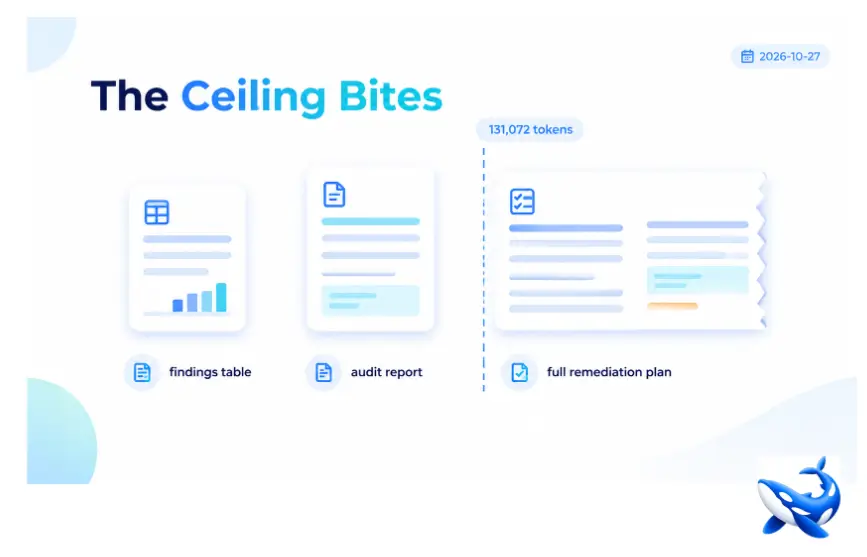

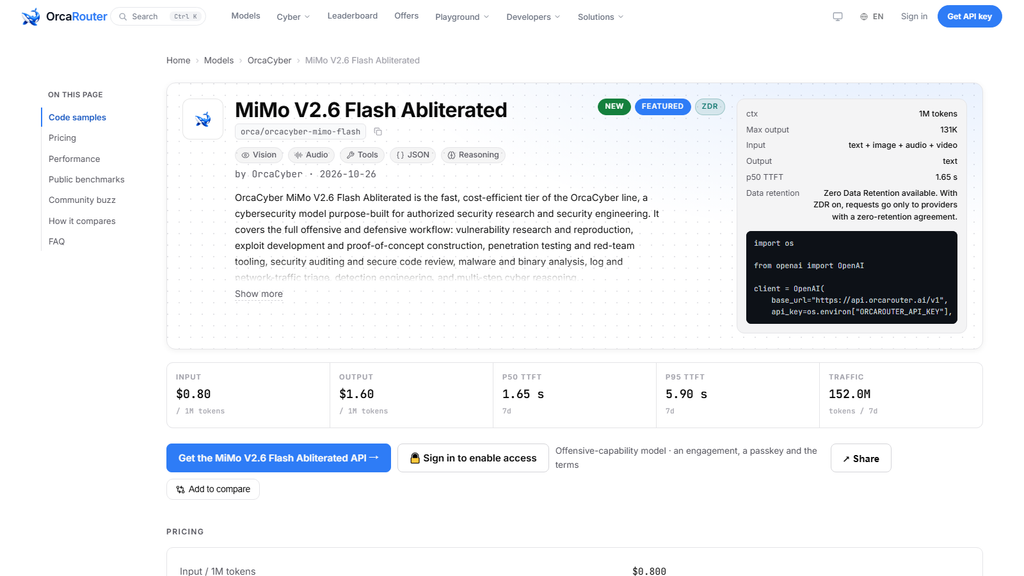
Through OrcaRouter the MiMo Flash output ceiling reads 131,072 tokens, and it is the card’s tightest constraint at $1.60 per million output [OURS]. The context window is a million; the writing room is an eighth of that. For an intake model that is a sensible split, and for a report generator it is the thing that breaks first.
Knowing what fits — and what truncation looks like — is worth ten minutes before you build.
What 131,072 tokens is
In artifact terms, roughly a hundred thousand words: a long technical report with evidence blocks, or a full findings set for a substantial engagement, or a complete transcript rewrite.
What it is not is a book, a full remediation programme with per-finding patches, or an annotated diff of a large repository. Those exceed it, and when they do, the model does not gracefully shorten — it stops.
How truncation actually presents
This is the part that catches people. A truncated response does not look broken.
It looks like an answer that ends, often at a sensible paragraph boundary, with no indication that anything is missing. The finish reason in the API response says `length`; the text itself says nothing.
Three habits follow.
Always check the finish reason. Before parsing, before displaying, before storing.
Ask for a summary line first. If the response begins with a short statement of what it will cover, a truncated one is visibly incomplete.
Cap the request below the ceiling. Asking for “up to 100,000 tokens” leaves headroom for the model to conclude rather than be cut.
Cost at the ceiling
A fully maxed response costs 131,072 × $1.60 / 1,000,000 = $0.2097 [OURS]. Twenty-one cents for the longest artifact the card can produce.
That number reframes the ceiling question. Twenty-one cents is not a budget problem; it is a design constraint. If the artifact needs more room, the answer is a second call or a different card, not a longer prompt.
For comparison, the DeepSeek-based sibling at the same input price offers a 393,216-token ceiling at $1.60 output — three times the room for the same per-token rate, and a maxed response costing $0.63 [OURS].
Splitting a long artifact
If the deliverable exceeds the ceiling, three ways to get it anyway.
Sections in sequence. Ask for the findings, then the remediation for each finding, then the executive summary. Each call is well under the ceiling and the joins are explicit.
One call per finding. Expensive in overhead, excellent in quality: each finding gets the model’s full attention and a fresh context.
Outline then expand. One call produces a structured outline that fits; subsequent calls expand each section. The outline doubles as a review point before the expensive part.
The first is usually the right default. It keeps a single authorial voice and the section boundaries are where you would have put them anyway.
Why the ceiling is smaller than the sibling’s
A smaller ceiling on a card tuned from a different base is not an oversight; it reflects what the two builds are for.
This card’s strengths are agentic: CyberGym 95.1, Terminal-Bench 2.1 87.6 [VENDOR]. An agent’s outputs are short — a tool call, a decision, a short synthesis. A hundred and thirty thousand tokens is generous for that.
The sibling’s strength is the written artifact, and its ceiling is three times larger for a reason.
Choose the card by the length of the thing you need written. That single question separates them faster than any benchmark table.
A practical budget for report work
If you are writing reports on this card, plan for three calls rather than one:
1. Findings (up to 30,000 tokens) — structured, schema-validated.
2. Remediation (up to 40,000) — one section per finding, with patches.
3. Summary (up to 5,000) — written last, from the two above.
Total output around 75,000 tokens, comfortably inside the ceiling, costing about $0.12 in output and well under a dollar with input [OURS]. The three-call structure also gives you three review points instead of one.
The ceiling interacts with the window
A request has two budgets, and they are not interchangeable: 1,048,576 tokens in, 131,072 out [OURS].
It is possible to send a million tokens and receive a hundred and thirty thousand, and it is possible to send fifty thousand and still receive the full ceiling. What is not possible is to treat the ceiling as elastic because the window is large — they are separate limits enforced separately.
The failure people hit is subtler: a prompt that says “produce a comprehensive report” against a large evidence set, where the model tries to write more than fits. It stops mid-sentence, and the first sign is in the finish reason.
Ask for a bounded artifact instead. “A findings table with these fields, plus a paragraph per finding” has a natural length, and it will not hit the ceiling however large the input.
See also: Top Paid Surveys in Australia for Earning Extra Cash
Benchmarks say nothing about this
None of the four published rows measures artifact length or truncation behaviour [VENDOR]. A model could score well on all of them and still truncate every long report.
That is not a criticism of the vendor — benchmark harnesses typically score task completion, not output volume. It is a reminder that the ceiling is a specification to design against, not a risk the benchmarks will surface.
A single test settles it for your workload: ask for the longest artifact you would ever need, with a real evidence set, and check the finish reason and the token count. One request tells you whether the ceiling is generous or binding for you.
The takeaway
131,072 output tokens is a long report and not a long programme. It costs twenty-one cents to fill, and when you exceed it the failure is silent unless you check the finish reason.
Design artifacts to the ceiling, split the ones that exceed it, and pick the card by the length of what you need written.
The finish-reason check is the single habit that prevents most of the surprises here, and it costs one line of code.
If you take one number from this piece, take the twenty-one cents: the cost of filling the ceiling is small enough that the ceiling should be treated as a design boundary rather than a budget. Everything expensive about a long artifact is the input that produced it, not the writing room itself.
Design the artifact to the room you have rather than the room you would like.
Sourcing note: output ceilings, prices and context windows are OrcaRouter catalogue data, checked 2026-10-27 [OURS]. Ceiling costs and the three-call budget are arithmetic on those rates. The benchmark rows referenced are the vendor’s own, evaluated 2026-09-20 [VENDOR].